The Cheapest H100 Is Out of Stock: What 25 Clouds of GPU Pricing Data Shows
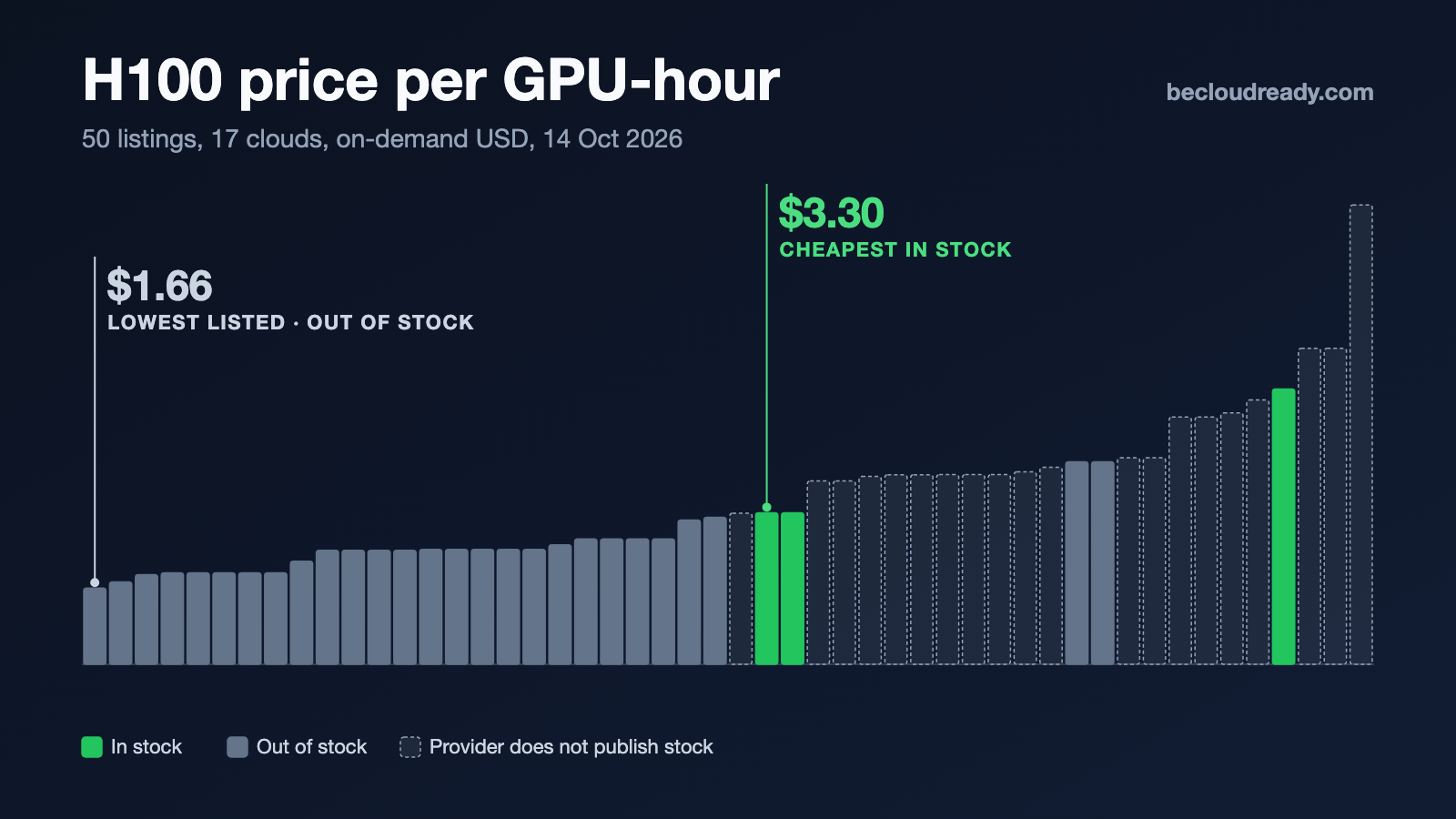
We track hourly GPU prices across 25 clouds every night. The cheapest H100 on our list is out of stock, and most providers do not publish stock at all. Here is what the data shows and how we handle it.
On 14 October 2026 the lowest H100 price in our tracker was $1.66 per GPU-hour, listed by Latitude. That row is marked out of stock. The cheapest H100 that a provider says you can rent right now is $3.30 per GPU-hour, at Scaleway. That is almost double.
This is the problem with most GPU price comparisons: they rank list prices and stop. A list price you cannot rent is not the best price. This post explains what we changed in our open GPU price tracker, what the data shows today, and where it cannot tell you the answer.
What we track
GPU Price is a free tracker we run for the data and AI teams we train. A scraper runs every night and publishes on-demand, per-GPU-hour prices from public pricing APIs and catalogs. No login, no scraping behind a form.
After this week's changes, the 14 October snapshot has:
- 518 priced offers across 25 providers (up from 436 offers and 18 providers before the change)
- Hyperscalers (AWS, Google Cloud, Azure, Oracle) and GPU-specialist clouds in the same table
- A per-GPU-hour price, so an 8-GPU node and a single-GPU instance compare fairly
The jump in coverage came from one fix. Our marketplace source, Shadeform, can return every offer or only the ones with stock. We were asking for in-stock offers only, which hid seven providers whose capacity was exhausted at the time: Latitude, IMWT, DigitalOcean, BoostRun, Voltage Park, Horizon and Phyntec. We now keep those rows and label them.
The new Availability column
Every row now carries an availability value:
- In stock: the provider reports capacity in at least one region. The price shown is the cheapest in-stock region, so it is a price you can rent.
- Out of stock: listed, but no region reports capacity. The price shown is the cheapest listed region.
- A dash: the provider does not publish stock, so we do not know.
The third case matters most. Stock data comes from the marketplace source only. AWS, Google Cloud, Azure, Oracle, RunPod, Lambda, Nebius and the other direct sources publish prices but no stock. Of 518 offers, 51 are in stock, 158 are out of stock and 309 are unknown. We do not guess for those rows.
What the data shows on 14 October
Median per-GPU-hour price of the offers in the tracker (not matched by instance size, so read these as a market snapshot rather than a benchmark):
| GPU | Offers | Providers | Lowest listed | Median | Highest listed |
|---|---|---|---|---|---|
| H100 | 50 | 17 | $1.66 (Latitude, out of stock) | $3.25 | $10.00 (Oracle) |
| H200 | 21 | 10 | $2.25 (Excess Supply, out of stock) | $5.29 | $10.60 (Azure) |
| B200 | 17 | 9 | $3.74 (BoostRun, out of stock) | $7.79 | $14.24 (AWS) |
| A100 80GB | 45 | 14 | $1.35 (Excess Supply, in stock) | $1.98 | $4.10 (Azure) |
| L40S | 46 | 12 | $0.69 (BoostRun, out of stock) | $1.70 | $7.58 (AWS) |
Three things stand out.
1. The cheapest listing is usually not rentable. For H100, H200, B200 and L40S the lowest listed price is marked out of stock. For H100, 27 of the 50 offers are out of stock, 3 are in stock and 20 are unknown. A ranking that ignores this tells you to go to a provider that has nothing to sell you.
2. Hyperscalers cost about twice as much at the median. The median H100 offer is $5.75 per GPU-hour on the four hyperscalers and $2.73 on everyone else. For A100 80GB it is $3.55 against $1.52. Some of that gap is real capacity guarantees, networking and enterprise terms. Some of it is simply price. Whether the gap is worth paying is a decision about your workload, and a price table cannot make it for you.
3. The spread within one GPU is wide. The highest H100 listing is six times the lowest. If your team defaults to one cloud for every job, you are probably paying the top of that range for work that does not need it.
What the data cannot tell you
We would rather list these than pretend.
- Unknown stock is not available stock. For H100, 20 of 50 offers have no stock data. The cheapest in-stock H100 we can verify is $3.30, but a direct provider with no stock signal could be cheaper and rentable.
- Marketplace prices can include a markup. Shadeform resells capacity from other clouds. A marketplace price may differ from the same provider's own price page, and the marketplace may list a provider that also appears elsewhere.
- On-demand only. Spot, reserved and committed-use prices are excluded. They can change the ranking.
- Stock changes within hours. The snapshot is nightly. Treat it as where to look first, not as a reservation.
- Per-GPU price is not total cost. Egress, storage, minimum commitments and setup time are not in the number.
What we changed in the wording
Because a list price is not an availability promise, the site now says "lowest listed price" rather than "cheapest". When the lowest offer for a GPU is out of stock, the page says so next to the price. We also removed the old Source column from the main table to make room for Availability, because a link to a generic provider page was not helping anyone choose.
Why this matters for data and AI teams
The teams we train run into this in two ways. A model training job that waits three days for capacity costs more than one that runs now at a higher hourly rate. And a team that budgets from list prices will see a different number on the invoice.
If you are planning GPU spend, a few habits help:
- Compare on in-stock price first, listed price second.
- Check at least two providers before committing, since the range within one GPU is so wide.
- Ask each provider for a capacity guarantee in writing for any job that must finish on a date.
- Re-check weekly. We keep a nightly history, so trends are visible over time as it builds.
What is next
Price history in our public archive started on 12 October, so week-over-week movement becomes measurable this month. We plan to cover which providers move prices, which change only their stock, and which listings come and go. If you want that analysis when it is ready, follow beCloudReady and TorontoAI.
The tracker is free at gpuprice.becloudready.com. If your team is deciding where to run AI workloads and wants help turning a price table into a cost and capacity plan, see our team workshops or contact us.
Data: public provider pricing APIs and catalogs, snapshot of 14 October 2026. Prices are USD per GPU-hour, on-demand. Check the provider before you commit.